Which roofing are you planning?
No votes yet. Yours will be the first. · saved on this device
Loading...
Gazebo Guidebook · Asphalt shingle roof vs Metal roof
Asphalt shingles cost $3 to $5 per square foot, match the house and are patched by any roofer; metal panels cost $5 to $30 per square foot, shed snow and leaves, and usually outlast the frame. On a small hip roof the hub flashing and cupola detail decide whether either one leaks, so the roofing bid should name that detail before the material.
A gazebo roof is small, steep and mostly joints. An octagon has eight hips meeting at a hub, and that geometry is why a $600 shingle roof and a $2,500 metal roof can both leak in year two if the peak was capped badly. This page compares the two materials on cost over ten years, climate, noise and heat, resale and the mistakes people make, using Angi's 2026 roofing table for the figures: shingles at $3 to $5/sq ft, metal at $5 to $30/sq ft.
Shingles match the house and cost least; metal sheds snow and debris and lasts longest. The hub flashing matters more than either.
| Factor | Asphalt shingle roof | Metal roof |
|---|---|---|
| Upfront cost | $3 to $5 per sq ft (Angi 2026) | $5 to $30 per sq ft (Angi 2026) |
| Lifespan | Comparable to house shingles; 15 to 25 years | Longest of common options; outlasts the frame on many gazebos |
| Maintenance | Check for lifted tabs after storms; easy patching | Replace aged fastener washers; keep laps clear |
| Appearance | Matches most houses; heavier look on small octagons | Crisp lines; standing seam suits modern homes, ribbed suits rural |
| Climate fit | Fine in most climates; holds snow | Sheds snow and leaves; loud in rain without a ceiling |
| Install time | A day on a typical octagon | A day or two; more cuts on octagons |
| Resale and ROI | Neutral | Slight edge where buyers value low upkeep |
| Best for | Matching the house on a budget | Snow country, under trees, longest life |
Shingles win when the gazebo should look like a small version of the house and the budget is tight; Angi's $3 to $5/sq ft is the cheapest durable roof. Any roofer can patch them.
Metal wins in snow country, under trees, and when you want the roof to outlast the frame. Angi's $5 to $30/sq ft range is wide because panel types vary; ask for the panel and gauge in the proposal. On either roof, the restoration page explains why the hub cap is the part that actually leaks.
Shingles belong on a gazebo meant to read as part of the house, in a mild or moderate climate, on a budget, and where a roofer is easy to find. A 12-foot octagon has roughly 150 to 170 square feet of roof surface, so Angi's shingle range is a few hundred dollars in material. They also belong on a low-pitch rectangular roof in a mild climate where snow is not the concern. Angi's table also lists wood shakes at $7–$15/sq ft, tile at $7–$25/sq ft and slate at $10–$30/sq ft, heavier choices that rarely suit a small hip roof.
Metal belongs under trees, in snow country, on a modern house with standing-seam lines, near the coast in an aluminum or coated form, and on any structure where the owner wants the roof to be the last roof. It also belongs on a kit hardtop by default, since most metal-frame kits ship with aluminum or steel panels. The restoration page is where the re-roof decision usually gets made on an existing structure.
On 160 square feet of roof, Angi's ranges give shingles at about $500 to $800 installed and metal at $800 to $4,800 depending on panel type, with a mid-range ribbed panel near $1,600 to $2,400. Over ten years shingles need a tab or two replaced after storms and are near the end of a gazebo-grade life by year fifteen to twenty; metal needs its fastener washers checked and replaced once. Neither needs much, and the ten-year cost difference is close to the up-front difference.
The cost that swamps both is the hub. A cupola added during a re-roof solves the peak flashing and adds ventilation; a hub cap re-flashed properly costs an hour of labour; a hub left alone rots the rafter tops from the inside regardless of what is on the slopes. Ask for the hub detail as a line item. The calculator treats the metal upgrade as a flat add-on over shingles for exactly this reason: the material choice is a modest premium on a small roof.
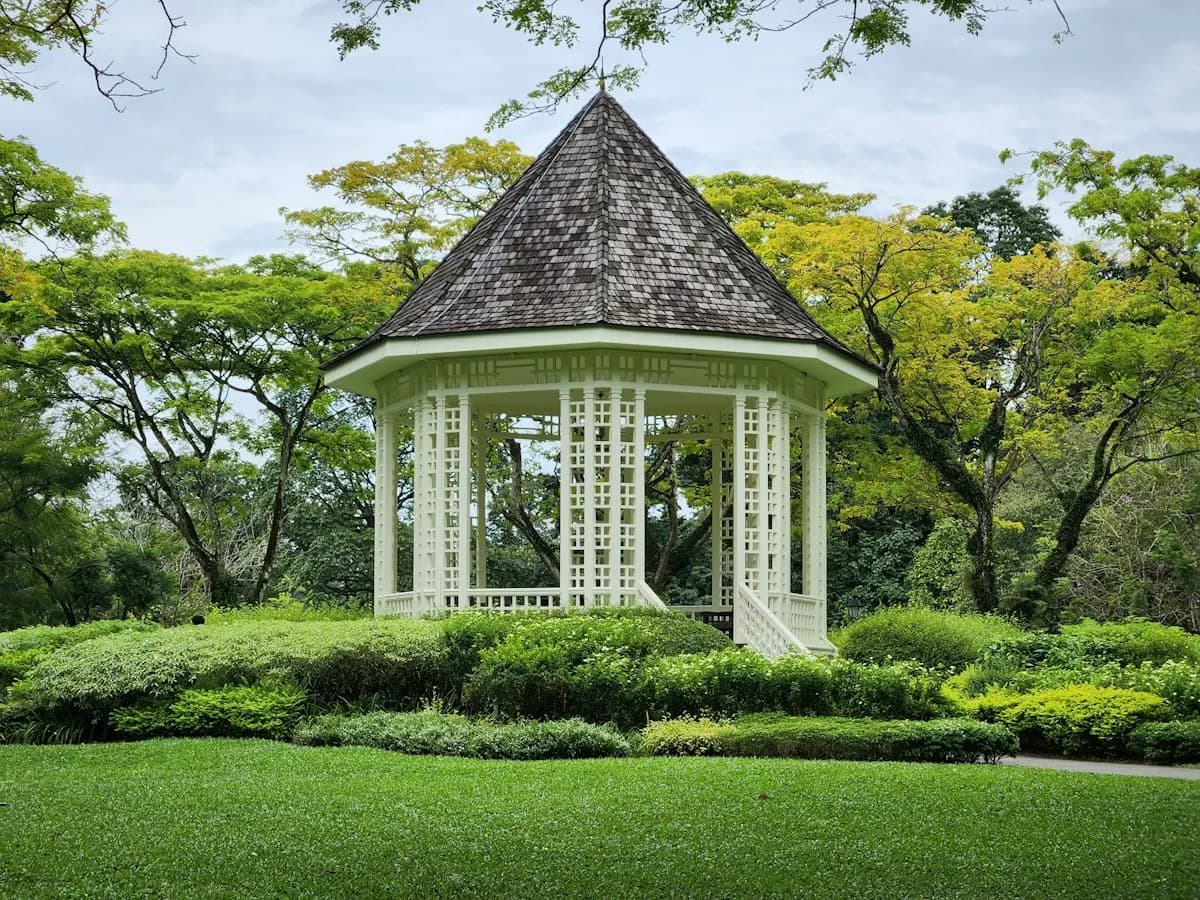
Snow slides off metal on a steep hip roof and sits on shingles, which is the whole argument for metal in the Northeast, upper Midwest and mountain West; less snow held means less load on rafters sized to the county's ground snow load. Under trees, shingles collect needles and leaves that stay wet and grow moss, while metal sheds them, which shortens the maintenance list for the 44.43% of homes the EIA's survey finds have large shade trees near the house.
Heat and noise cut the other way. A bare metal roof radiates heat down into the gazebo and turns rain into a drum; a ceiling or a layer of insulation board under the panels fixes both and adds cost. Shingles over a plywood deck are quieter and cooler by default. In the South, a light-coloured metal roof with a ceiling or a vented cupola is the usual compromise; Modern Shade's Florida lifespan of 7 to 12 years reflects UV and salt that a coated metal roof resists better than shingles.
Barely, on its own. The National Association of Realtors' 2023 report attributes value to outdoor features broadly, with a new patio recovering 95% of its cost, and buyers judge a gazebo by whether it looks sound and matches the house. A shingle roof that matches the main roof reads as intended; a bright metal roof on a traditional house can read as an afterthought unless the house has metal accents already.
Where the roof material does matter is condition at listing. A gazebo with lifted shingles and moss photographs as a chore; a metal roof photographs clean. If a re-roof is due in the year before a sale, the cheaper shingle job usually returns as much as the metal one. The repair versus replace comparison covers the pre-sale decision on the rest of the structure.
Shingle mistakes: using three-tab shingles on a pitch too low for them, skipping underlayment on a small roof because it seems unimportant, cutting hip caps from field shingles without sealing, nailing through the hub, and matching the house colour so closely that the gazebo reads as a shed. Metal mistakes: buying the thinnest panel because the range is wide, over-driving screws so the washers split, running panels without closure strips so wasps and rain enter at the eaves, using steel near salt, and forgetting the ceiling or vent in a hot climate.
Both share one mistake: hiring on the slope material and ignoring the hub. Ask any roofer or builder how the peak will be flashed or capped and whether a cupola is included, and ask what happens if the rafter tops are soft once the old roof is off. The materials article lists the other hardware details that outlast the choice of panel or shingle.
Get both materials priced on the same roof area, and insist on the area in square feet on the bid so the per-foot figure can be checked against Angi's table. Then look for the hub, the hips, the eave detail and the disposal of the old roof, each as a line. A bid that is one number for 'metal roof' or 'shingles' is a bid you cannot compare. On an existing gazebo, ask whether the rafters and sheathing were inspected and what happens if rot is found under the old roof; that is the change order most re-roofs generate.
If the metal bid is at the top of Angi's range, the panel should be standing seam or a heavy gauge; if it is at the bottom, ask what closure and fastener details are included. If the shingle bid is far below the range, underlayment or the hub is probably missing. Send the same description to two or three pros through the estimate request and ask each for both materials as alternates.
Homeowner polls
No votes yet. Yours will be the first. · saved on this device
No votes yet. Yours will be the first. · saved on this device
For light and a budget between the two, yes, at Angi's $10 to $20 per square foot. It lets daylight in, which helps a shaded garden corner, but it traps heat over a dining table and yellows in strong UV. It suits a reading retreat more than a Southern dining gazebo.
Dark metal absorbs heat, but a gazebo is open-sided so the effect is smaller than on a house. Lighter colors and a vented cupola reduce it. The real complaint is noise in rain, which a ceiling under the rafters solves.
Roughly 150 to 180 square feet depending on pitch and overhang. The floor of a 12-foot octagon is about 119 square feet; the roof projects past the posts and slopes, which adds a third or more. Ask the pro to state the roof area on the bid so Angi's per-square-foot ranges, $3 to $5 for shingles and $5 to $30 for metal, can be checked against the total.
Sometimes, with battens and a check that the rafters can carry the added weight and that the hub can be re-flashed through both layers. On a small roof the labour to strip shingles is modest and the result is better, so most pros recommend removal. Overlaying also hides rot in the sheathing that a strip would reveal, which is the main argument against it on an older structure.
Metal, once installed correctly. The annual task is a look at the fastener washers and a clear of the eaves; every ten years or so the washers are replaced. Shingles need lifted tabs pressed or replaced after storms and moss removed under trees. Neither is demanding, and on both the hub or cupola is the part to check each spring for staining on the rafters below.
Not usually on a gazebo. Metal panels are lighter than shingles over a deck and can span purlins or a plywood deck at the same spacing. What changes is the fastening: panels need solid backing or purlins at the panel manufacturer's spacing, and standing seam needs a flat deck. A pro converting a shingle roof to metal will check the rafters for rot and add purlins where needed.
Cedar and vinyl kits are often designed for shingles over a plywood or plank deck and ship with the deck; Yardistry's cedar models ship with an aluminum roof, and many hardtop kits are metal by design. Replacing a kit's metal roof with shingles is rarely worth it. Replacing a kit's worn shingles with metal is a common restoration and follows the same rules as on a custom roof.
Shingles over a plywood deck, or metal over a deck with an insulation board and a ceiling. Bare metal on purlins is the loudest. If metal is chosen for snow or trees, budget for a tongue-and-groove or bead-board ceiling; it also hides the underside of the panels and gives fixtures something to mount to, which is why many custom builders include it by default on a metal roof.
 ComparisonCedar gazebo vs Vinyl gazebo
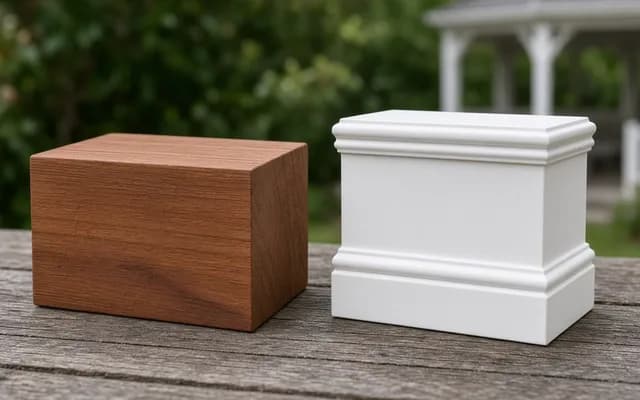
Cedar costs less up front, repairs easily and looks like a garden building, but needs finish every one to two years to reach 20 to 25 years.
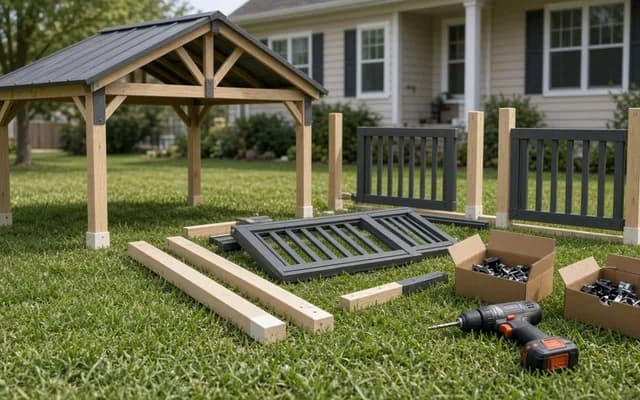 ComparisonGazebo kit with assembly vs Custom-built gazebo
A kit with professional assembly costs $3,600 to $8,600 for the product plus $500 to $1,500 to assemble and delivers a known interior at a known rating in a weekend.
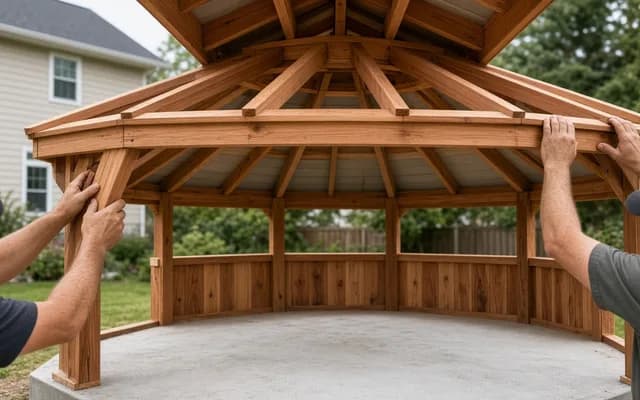 ComparisonOctagonal gazebo vs Rectangular gazebo
An octagonal gazebo costs $5,000 to $12,000 installed against $3,000 to $10,000 for a rectangle in Fixr's shape table, and its eight-sided plan seats four comfortably where a rectangle of similar footprint seats six or more.
ComparisonRestore the existing gazebo vs Replace with a new build or kitRepair when the posts are sound at grade, the frame is stiff under a push and the hub can be re-flashed, and the list is roof, screens, floor and finish.
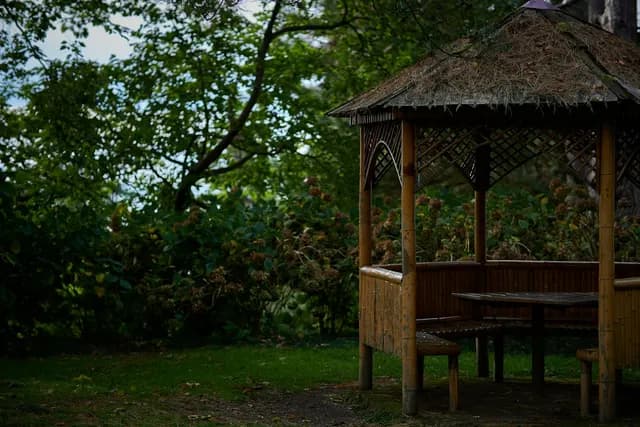 ComparisonGazebo vs Pergola
A gazebo has a solid roof, keeps off rain and costs about $7,590 on average installed per LawnLove, with most paying $5,365 to $9,025.
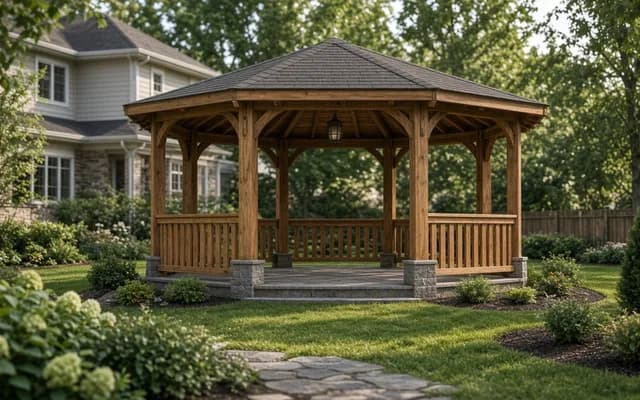 Service guideCustom Gazebo Construction
Custom gazebo construction designs the interior dimensions, roof form, supports, base, screens and lighting as one scope for a specific garden or seating layout.
 Service guideGazebo Kit Assembly
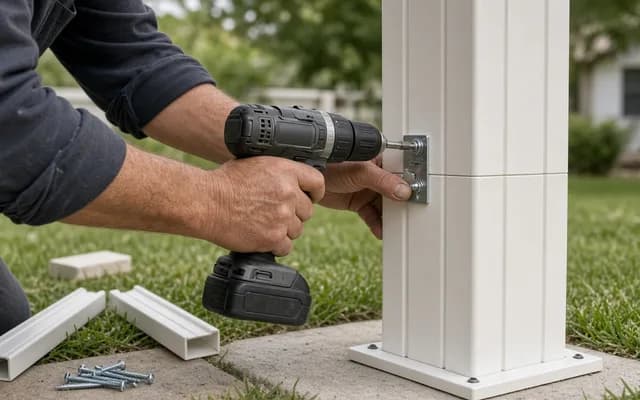
Gazebo kit assembly is the professional build of a delivered kit on a prepared base: unloading, parts inventory, anchoring, assembly, roofing and cleanup.
 Service guideGazebo Restoration & Repair
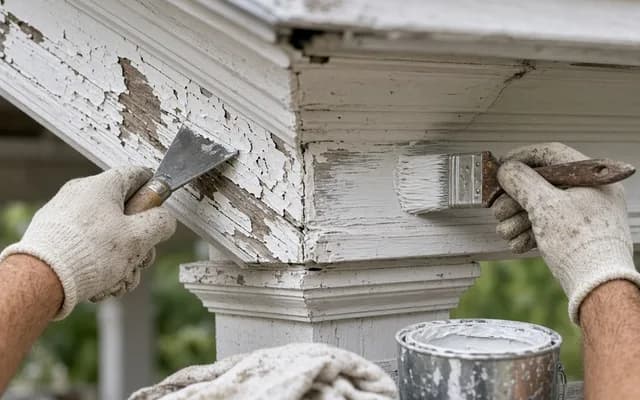
Gazebo restoration and repair covers leaking roofs, deteriorated posts, loose connections, worn decking and tired finishes on a structure worth keeping.
 Free toolGazebo cost calculator
Size, material tier and complexity in, a realistic budget range out.
 Free toolGazebo planning quiz
10 questions that show what you already know and what to check next.
 Free toolGazebo polls
See what other planners chose and add your vote.
Tell us the size, the condition of what is there now, and what you want to change. Gazebo Guidebook passes your request to independent local professionals, who reply with written, no-obligation estimates. The service is free to use.